
Introduction
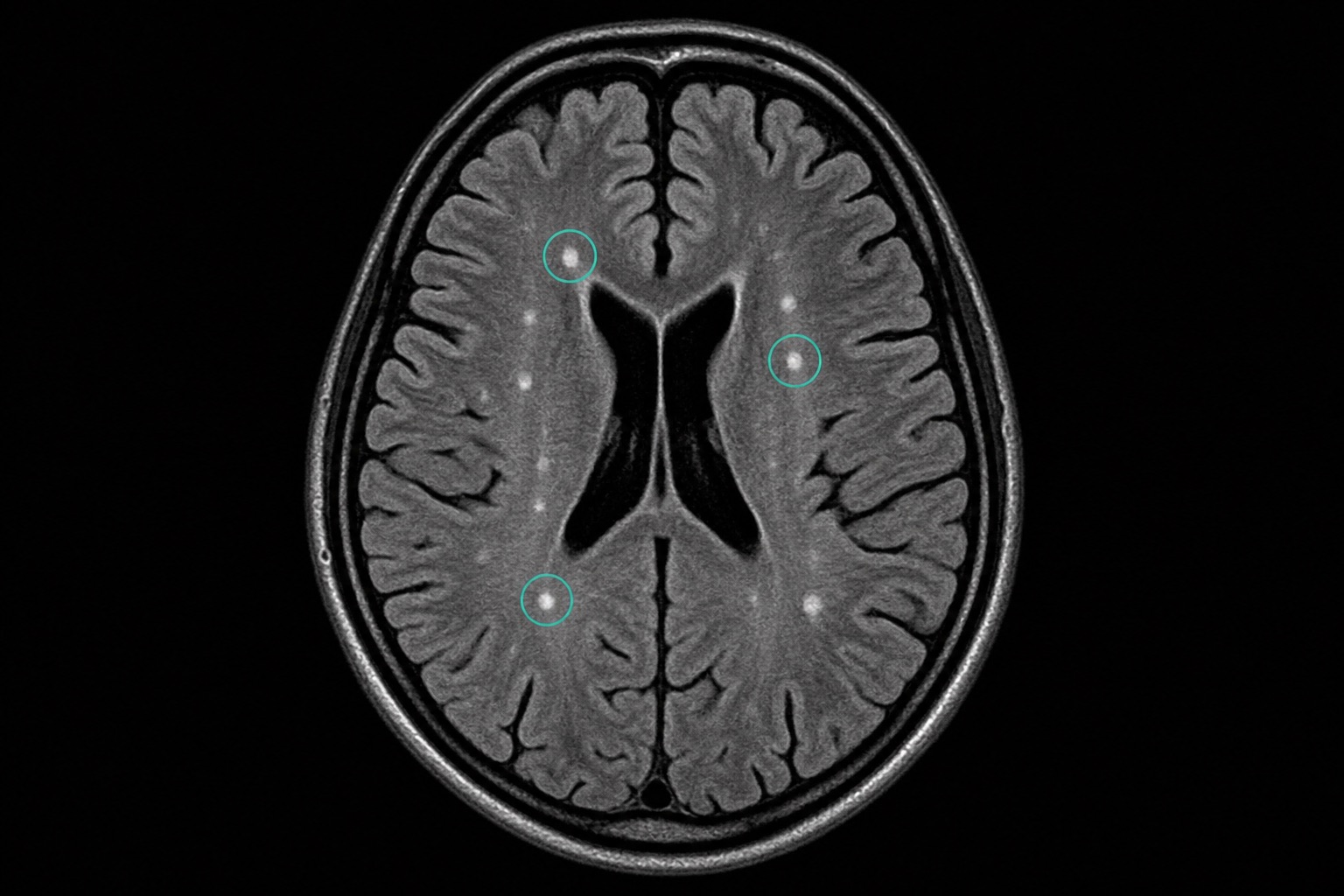
“White spots” on a brain MRI usually refer to small bright areas seen on T2-weighted or FLAIR sequences. Doctors often call them white matter hyperintensities (WMH). Seeing them on your report is anxiety-provoking, but in many cases they are benign and age-related. This guide explains what white spots can mean, when to worry, and what follow-up might be recommended.
The phrase white spots on brain MRI is a patient-friendly way to describe a technical MRI finding: T2/FLAIR white matter hyperintensities. White spots on brain MRI are not a diagnosis by themselves. Their meaning depends on age, symptoms, vascular risk factors, migraine history, lesion location, lesion size, and whether the spots enhance with contrast or change over time.
Key takeaways about white spots on brain MRI
- White spots on brain MRI are common. Small punctate white matter hyperintensities become more common with age, high blood pressure, diabetes, smoking, and migraine.
- White spots on brain MRI are pattern-based. Periventricular, juxtacortical, corpus callosum, brainstem, or cerebellar lesions may carry different significance.
- White spots on brain MRI need symptoms for context. Numbness, weakness, vision loss, imbalance, or cognitive changes make the finding more important.
- White spots on brain MRI should be compared over time. Stable lesions are often reassuring; new or enhancing lesions need closer follow-up.
1. What are white matter hyperintensities?
On FLAIR (fluid-attenuated inversion recovery), normal brain tissue looks grey and the spinal fluid looks dark. Areas of injured or inflamed white matter contain extra water, so they appear bright (“hyperintense”). The brightness itself is non-specific — many different conditions can cause it.
2. Common causes by age
- Older adults (50+): small vessel ischemic disease (chronic hypertension, diabetes, smoking, aging) is by far the most common cause. Often called “leukoaraiosis”.
- Younger adults: migraine-associated white matter spots, multiple sclerosis (MS), post-infectious changes, demyelinating disorders.
- Any age: head injuries, vasculitis, certain medications, prior stroke.
3. The MS pattern
Multiple sclerosis lesions tend to be ovoid, larger than 3 mm, located in the periventricular white matter (Dawson’s fingers), juxtacortical, in the corpus callosum, and in the brainstem or cerebellum. Lesions may enhance with gadolinium when active. A neurologist uses the McDonald criteria, which combine clinical history with MRI patterns.
Common brain MRI report phrases
A brain MRI report may describe “mild chronic microvascular ischemic change,” “non-specific T2/FLAIR hyperintensities,” “scattered punctate foci,” or “periventricular white matter lesions.” These brain MRI phrases do not all mean the same thing. Mild chronic microvascular change on brain MRI is often related to age and vascular risk factors, while a demyelinating pattern on brain MRI may require neurology follow-up.
Brain MRI interpretation is strongest when the radiologist compares location, shape, enhancement, diffusion, and prior imaging. If a brain MRI shows white spots that are stable over several years, that is different from a brain MRI showing new enhancing lesions. If a brain MRI finding is described as “non-specific,” the report is usually saying the spot does not point to one single diagnosis.
In short, brain MRI context matters: the same bright spot on brain MRI can be harmless in one person and clinically important in another.
4. The small vessel disease pattern
Vascular white matter changes are usually scattered, deep, and symmetric, often in the periventricular and deep white matter. They are graded with the Fazekas scale (0-3). Mild changes (Fazekas 1) are very common in older adults; moderate-to-severe changes (Fazekas 2-3) correlate with risk factor control needs.
5. When to worry
- New-onset neurological symptoms (numbness, weakness, vision loss).
- Progressive lesions on follow-up MRI.
- Lesions with contrast enhancement (active inflammation).
- Pattern matching MS, vasculitis, or other inflammatory disease.
If your report describes “non-specific” or “age-related” white matter changes and you have no symptoms, this is usually reassuring.
6. Typical follow-up
- Cardiovascular risk modification: blood pressure, cholesterol, smoking cessation.
- Repeat MRI in 6-12 months if there is concern for an evolving inflammatory or demyelinating disease.
- Neurology referral for any new symptoms or atypical MRI patterns.
Want a plain-language interpretation of your brain MRI? Try our AI brain MRI analysis tool.
When reading a report about white spots on brain MRI, look for the radiologist's exact wording: “mild chronic microvascular ischemic change,” “non-specific white matter hyperintensities,” “demyelinating pattern,” or “active enhancing lesion.” Those phrases are more informative than the number of spots alone.
Frequently asked questions
Related articles
How to Read a CT Scan: A Beginner’s Guide
Learn how to read a CT scan step by step: axial slices, coronal and sagittal views, Hounsfield units, CT window settings, key anatomy, and urgent red flags.
How to Read an MRI Scan
Learn how to read an MRI scan in plain language: T1 vs T2, FLAIR, DWI/ADC, contrast enhancement, image planes, artifacts, and report terminology.
How to Read a Chest X-Ray
Learn how to read a chest X-ray using a systematic ABCDE method: image quality, airway, lungs, heart size, diaphragm, common abnormalities, and red flags.


