
Introduction
A chest X-ray is the most common medical imaging test in the world. Whether it was ordered for a cough, chest pain, or pre-operative screening, learning to read it systematically helps you understand findings such as “clear lung fields”, “widened mediastinum”, or “no pleural effusion”.
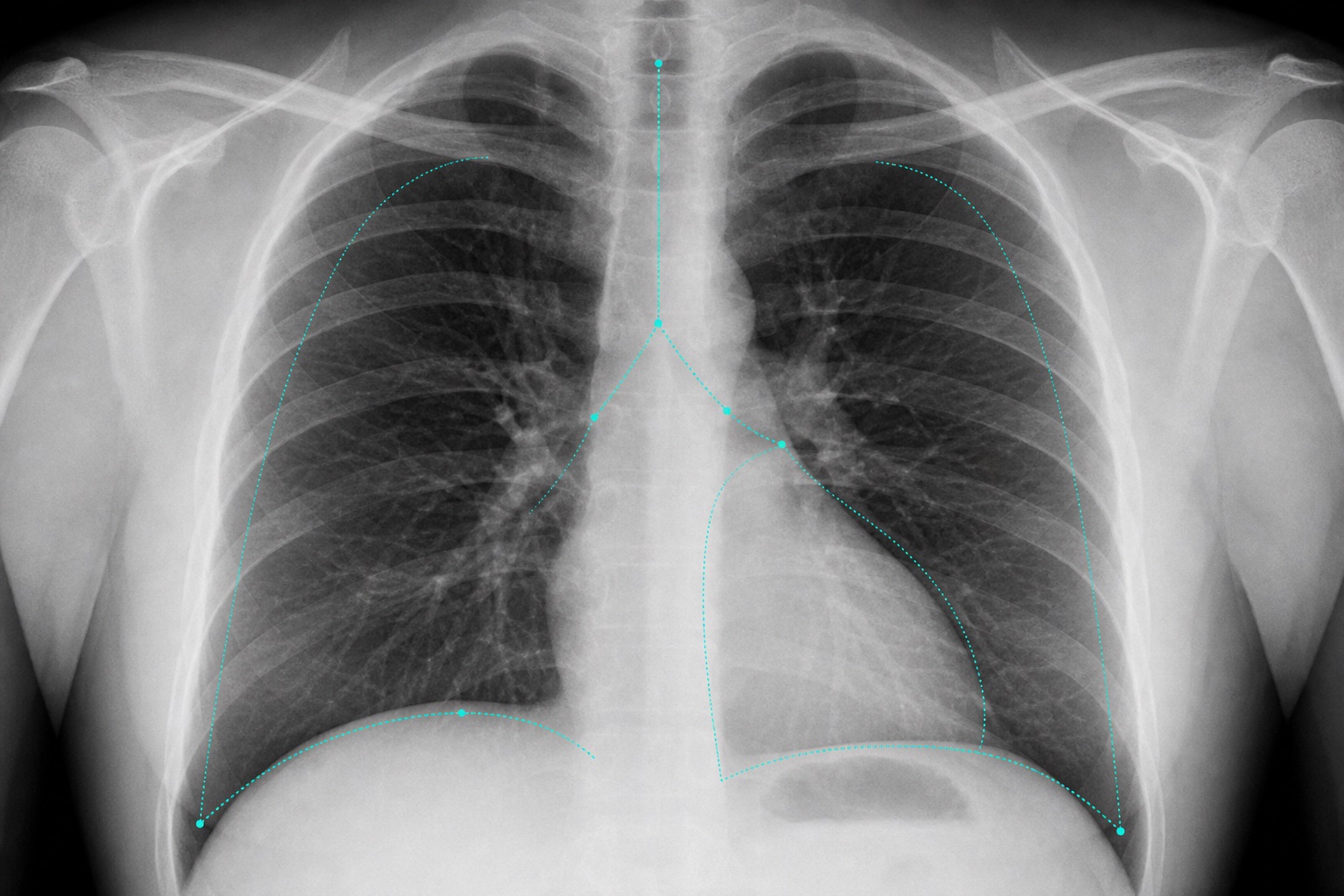
If you searched for how to read a chest X-ray, the most important skill is not memorizing every disease — it is using the same chest X-ray interpretation checklist every time. A systematic chest X-ray reading method helps you notice image quality, airway position, lung opacity, heart size, pleural effusion, pneumothorax, bones, and medical devices without jumping to conclusions too early.
Key takeaways before reading a chest X-ray
- Chest X-ray interpretation begins with quality. Rotation, penetration, inspiration, and projection can mimic disease.
- Chest X-ray findings are often pattern-based. Consolidation, edema, effusion, pneumothorax, and atelectasis each create different visual patterns.
- Chest X-ray comparison is powerful. A prior chest X-ray can reveal whether a nodule, scar, or opacity is new or stable.
- Chest X-ray interpretation has limits. CT is needed when pulmonary embolism, small lung nodules, aortic disease, or subtle fractures remain possible.
1. Check image quality first
- Inspiration: the diaphragm should be at the level of the 9th-10th posterior rib. Poor inspiration crowds the lung markings.
- Penetration: vertebrae behind the heart should be just barely visible.
- Rotation: the medial ends of the clavicles should be equidistant from the spinous processes.
2. The ABCDE method
A widely-taught systematic approach for chest X-rays:
- A — Airway: trachea midline? Carina visible?
- B — Breathing/Lungs: are both lung fields clear, or is there opacification, nodules, or consolidation?
- C — Cardiac: heart size (cardiothoracic ratio < 50% on PA), borders sharp?
- D — Diaphragm: smooth domes, no free air under the diaphragm, costophrenic angles sharp (no effusion)?
- E — Everything else: bones (rib fractures), soft tissue (subcutaneous emphysema), lines/tubes (ET tube tip 4-5 cm above carina).
3. Common patterns to recognize
- Pneumonia: focal opacity, often with air bronchograms.
- Pulmonary edema: bilateral perihilar haze, Kerley B lines, sometimes pleural effusions.
- Pleural effusion: blunting of costophrenic angles; on supine films, only diffuse haziness on the affected side.
- Pneumothorax: thin pleural line, no lung markings beyond it.
- Cardiomegaly: heart wider than half the thoracic cavity on a PA film.
4. The silhouette sign
When two structures of the same density touch, their borders disappear. A loss of the right heart border on a chest X-ray suggests right middle lobe pathology; loss of the left heart border suggests lingula. The silhouette sign is one of the most useful localization tools.
5. Common pitfalls
- Skin folds, overlying braids, ECG leads can mimic pneumothorax lines.
- Nipple shadows can look like nodules — check both sides.
- A poorly inspired film makes everything look worse than it is.
Next steps
For specific subtypes, see our pages on chest X-ray interpretation, or upload your X-ray to our AI chest X-ray analysis tool for instant feedback.
The best way to learn how to read a chest X-ray is to apply the ABCDE method to every film, even if the report says “normal.” Repetition builds a mental map of normal chest X-ray anatomy, making abnormal chest X-ray findings easier to recognize.
Frequently asked questions
Useful tools
Related articles
How to Read a CT Scan: A Beginner’s Guide
Learn how to read a CT scan step by step: axial slices, coronal and sagittal views, Hounsfield units, CT window settings, key anatomy, and urgent red flags.
How to Read an MRI Scan
Learn how to read an MRI scan in plain language: T1 vs T2, FLAIR, DWI/ADC, contrast enhancement, image planes, artifacts, and report terminology.
White Spots on Brain MRI: What They Mean
Understand white spots on brain MRI: T2/FLAIR white matter hyperintensities, migraine spots, small vessel disease, MS patterns, risk factors, and follow-up.


